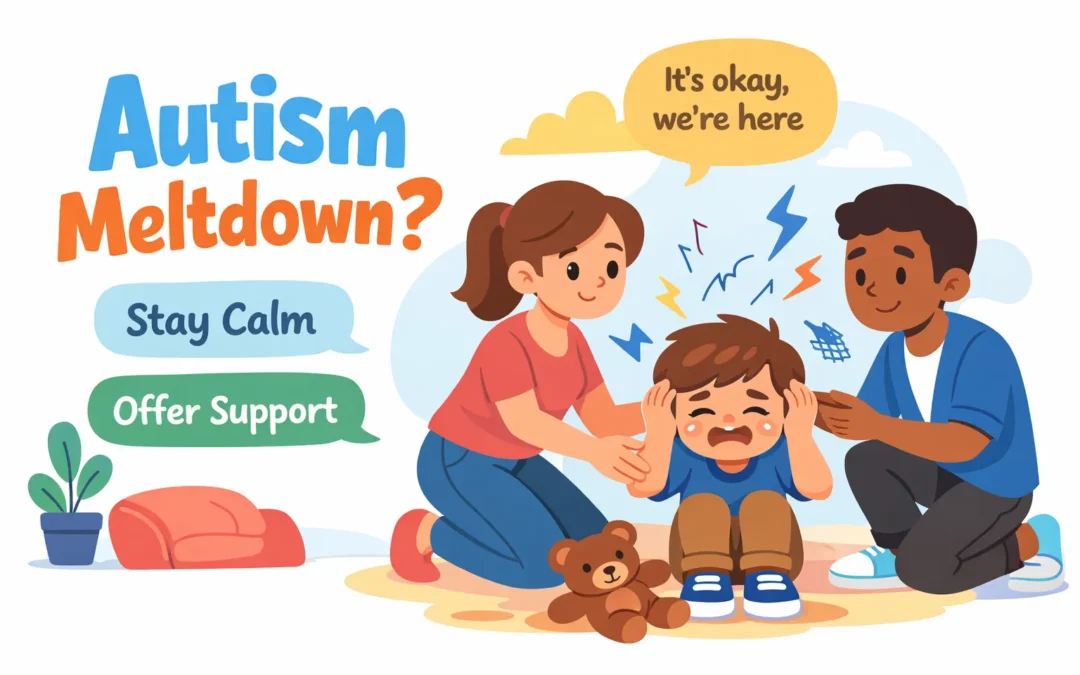
You’re in the cereal aisle, or maybe you’re already home, and something shifts. Your child goes from fine to not-fine in what feels like a single breath. The crying, the floor, the sounds that don’t stop, the faces of strangers, and you standing there trying to figure out what to do first. If you’ve lived through an autistic child’s meltdown, you know this feeling exactly. And if you’re reading this before it happens again, you’re already one step ahead.
Knowing how to handle an autism meltdown, before it builds, while it’s happening, and after the dust settles, isn’t about having a perfect response every time. It’s about having a reliable one. This guide walks you through all three phases, including recovery for your child and for you.
What a meltdown actually is (and what it isn’t)
Meltdown vs. tantrum: the key distinctions
This distinction matters more than it might seem, because it completely changes how you respond. A tantrum is goal-directed. The child wants something, knows they want it, and is using behavior to get it. It typically stops the moment they get what they’re after, or when they realize it isn’t working. A meltdown is something else entirely. It’s a neurological overload event, not a strategy. Your child isn’t performing, manipulating, or testing you. Their nervous system has been overwhelmed past its capacity, and they have lost control of their own response.
The observable cues help you tell them apart. Meltdowns are audience-independent: they happen whether you’re watching or not, whether you give in or don’t. Redirection doesn’t work in the moment. The episode often lasts 20 to 30 minutes or more after the triggering stressor is removed. And afterward, your child is genuinely exhausted, not triumphant.
Meltdown vs. shutdown: recognizing both
Many parents brace for the explosive version and completely miss the shutdown. A shutdown is the internal collapse: the child goes quiet, unresponsive, disconnected, sometimes unable to speak. They may stare blankly, stop reacting to their name, or seem almost absent. It’s easy to misread as calm, or even as sulking. Both meltdowns and shutdowns come from the same place, sensory or emotional overload, but they show up as opposite behaviors. Understanding both helps you read your child accurately instead of being caught off guard by the quiet version.
Spotting warning signs before the meltdown hits
The early signals that tell you something’s building
Most meltdowns don’t arrive without warning. They have a lead-up phase that parents can learn to read, and that window is where prevention lives. Common early signals include increased stimming such as rocking, hand-flapping, or pacing; covering ears or eyes; rising rigidity or repetitive questioning; difficulty communicating; and withdrawal from interaction. The child’s energy shifts before the explosion does.
The important caveat: these signals are unique to every child. Your job isn’t to memorize a universal checklist. It’s to learn your specific child’s escalation pattern, which takes time and attention, not perfection.
Keeping a simple trigger log
A brief, consistent log reveals patterns faster than memory does. After a meltdown, jot down three things: what was happening before it started (the environment, activity, demand, or sensory input), what your child did, and what followed. Within a few weeks, you’ll start to see the shape of your child’s triggers. Those patterns become the foundation of your whole prevention strategy.
If you’re in the early weeks after a diagnosis and feeling overwhelmed by where to start, the free What to Do in the First 30 Days After Your Child’s Autism Diagnosis includes guidance on exactly this kind of pattern-spotting as part of getting grounded after diagnosis. It’s free, no sign-up required, and built for parents who are still in the thick of figuring things out.
How to respond to an autism meltdown in the moment
Regulate, relate, then reason, in that order
Therapists who work with autistic children often describe a three-phase approach, and parents who use it consistently find it genuinely helpful: regulate first, relate second, reason last. It works because it follows how the brain actually recovers from overload, rather than fighting against it.
Start with regulate: reduce stimulation, say less, slow your own movements, and get physically calm. Then relate: stay present, offer gentle choices, validate without lecturing. Only after your child has genuinely settled do you reason: discuss what happened, acknowledge their self-regulation efforts, and gently explore what was hard. The sequence matters because during a crisis state, the brain simply cannot process language or logic. Trying to talk a child through a meltdown while it’s happening works against neuroscience, not with it. This sequencing is supported by research on de-escalation and self-regulation (evidence-based review).
Step-by-step actions for the first few minutes
When a meltdown begins, the order of your actions matters. Lower your voice and slow your movements first, your nervous system directly influences theirs, and calm is as contagious as panic. Then reduce sensory input immediately: dim the lights, turn off background noise, and create physical space if you can. Use minimal words. Something like “I’m here, you’re safe” is enough, repeated calmly if needed.
From there, drop all demands. Don’t insist on eye contact or physical compliance, those escalate rather than help. Offer a sensory item or preferred object by placing it nearby rather than pressing it into their hands. And then comes the hardest part for most parents: wait. Let their nervous system do its work. You’ve done what you can for now, and that matters more than it might feel like in the moment.
What not to do during a meltdown
The responses that feel natural in the moment are often the ones that make things worse. Raising your voice is one. Demanding explanations is another. So is threatening consequences, forcing eye contact, or moving the child abruptly from a space without preparation. Each of these escalates rather than de-escalates. This isn’t a criticism of any parent who has done these things, they’re instinctive responses to distress. They just don’t work during an overload state, and knowing that in advance saves everyone a lot of pain.
Adjusting the sensory environment quickly
Immediate changes that reduce overload
Your goal in the moment isn’t to solve the trigger. It’s to lower the total sensory load on your child’s nervous system. Turn off harsh overhead lights or dim them. Reduce or eliminate background noise from TVs, music, or appliances. Create physical space away from crowds or tight environments. Each of these removes one layer of input, and together they give the nervous system room to start recovering. For practical calming strategies recommended by national autism organizations, see calming techniques in autism.
Sensory tools worth keeping on hand
The most effective sensory tools for meltdown de-escalation include noise-cancelling headphones, weighted blankets or lap pads, fidget items, chewable jewelry, and stress balls. Movement-based options like jumping, walking, or bouncing on a therapy ball are also genuinely helpful. The critical detail: these tools work best when introduced during calm periods, so your child already associates them with relief. A weighted blanket that appears for the first time mid-meltdown is unfamiliar and potentially alarming. One that your child uses during quiet time becomes an anchor they can reach for when things get hard.
For more on sensory processing and why these tools help, review research on sensory processing in autism.
Building a calm-down space at home
A sensory corner doesn’t need to be elaborate or expensive. It needs to be consistent, low-stimulation, and genuinely the child’s own. A beanbag, a few preferred sensory items, soft lighting, and clear access are enough. What matters most is practicing using it during non-crisis moments. When your child retreats to this space during calm times, it becomes a reliable anchor rather than a strange place they’re sent to when things go wrong.
When a meltdown turns physical: safety first
Keeping your child safe from injury
The first priority in a physically escalated meltdown is removing hazards from the environment, not removing the child. Clear hard objects, swap sharp-cornered surfaces for softer ones, and create open space. What specialists agree on is that physical restraint should be reserved as an absolute last resort, only when there is an immediate and serious safety risk, and only with prior training. Restraint is not a de-escalation tool, and its risks, including injury, loss of trust, and lasting distress, are real and well-documented.
It’s also worth checking whether pain is driving the meltdown. Gastrointestinal discomfort, an ear infection, a fabric irritant, these physical causes are more common than many parents realize. If physical meltdowns are recurring, a behavior specialist or pediatrician can help you assess what’s underneath.
Managing a physical meltdown in public
This is one of the hardest situations parents face, and it deserves honesty rather than just strategy. You will feel watched. You will feel judged. And you will be doing your best in one of the most stressful moments parenting has to offer. Practically speaking: identify quiet exit points in advance when you’re somewhere new, focus on containing rather than correcting in the moment, and know that recovery takes time. Most people around you are more understanding than your fear suggests. And the ones who aren’t are not your responsibility right now.
After the meltdown: recovery for your child and for you
Helping your child come back to baseline
After a meltdown, your child needs quiet, low-demand time. Not a debrief, not consequences, and not an immediate conversation about what happened. Wait until they’re genuinely calm and verbal. When you do talk, keep it brief: validate what they felt, avoid blame, and gently explore what was hard. If they managed any self-regulation during the meltdown, even small attempts, acknowledge it. That positive reinforcement builds the skill over time.
Taking care of yourself after the meltdown
Caregivers absorb the stress of meltdowns too, and that’s not weakness. It’s physiology. Once your child is safe, step away for a few minutes if you can. Practice a brief regulation technique: slow breathing, a short walk, even splashing cold water on your face. Resist the urge to immediately analyze or problem-solve. The meltdown is over. Your nervous system needs to recover before your brain can usefully process what happened.
The longer-term reality is that parenting an autistic child is a marathon, not a sprint. Running on empty doesn’t just affect you, it affects your ability to respond well the next time. Your wellbeing is part of the plan, not an afterthought.
Putting it all together: a simple written meltdown plan
A written plan doesn’t need to be formal or long. One page is enough. Cover your child’s known triggers, their early warning signs, what helps and what definitely doesn’t, which sensory tools work for them, and who to contact in a genuine crisis. The point isn’t perfection. The point is that the plan exists, that it’s visible to anyone who cares for your child, and that it gets updated as you learn more. That document becomes your reliable response, the thing you reach for when your brain goes blank in a hard moment. For templates and worksheets you can adapt, see the Autism Speaks crisis planning toolkit.
How to handle an autism meltdown: start with one step
That parent from the cereal aisle is still figuring this out. So are you. Handling an autism meltdown well is a skill you build through practice and observation, not something you’re supposed to arrive at already knowing. Every improvement you make in your response, your child’s environment, or your preparation makes a real, measurable difference to both of you.
You showed up to read this. That means you’re already doing something right. Start with the step that feels most doable right now, whether that’s a trigger log, a calm-down corner, or a one-page written plan. You don’t need all of it at once. You just need somewhere to begin.
For more practical, free guidance on understanding your child’s diagnosis and navigating the early weeks, Autism & Parents is built exactly for this moment. No sign-up, no paywall, just clear information for parents who are still finding their footing.