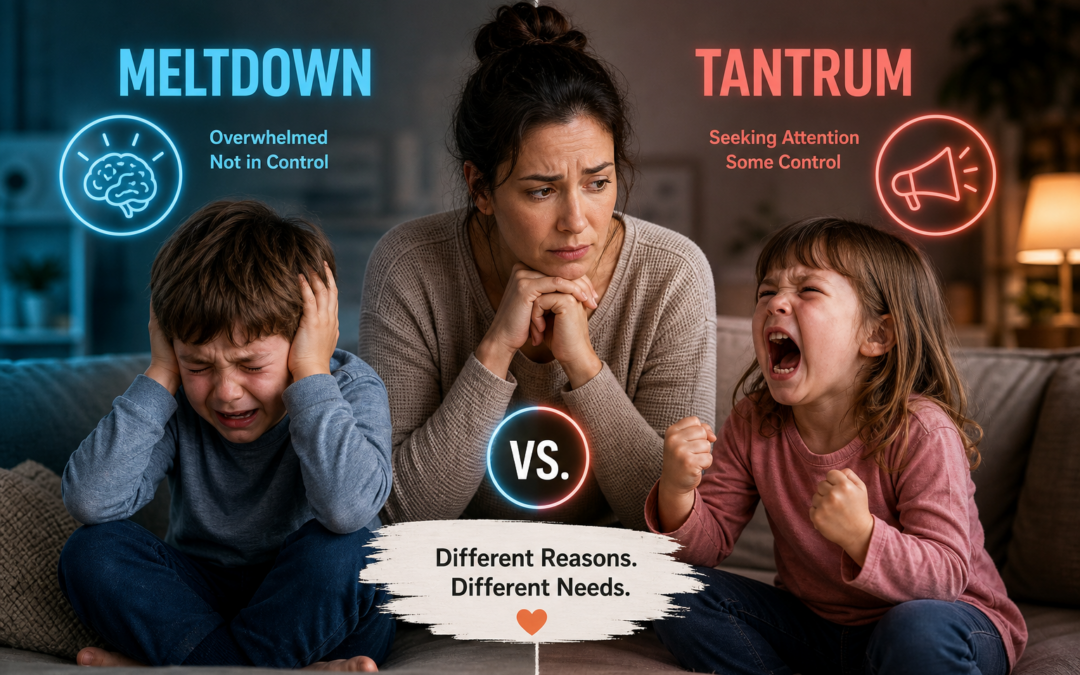
Picture this: you’re at the grocery store with your 3-year-old. One minute everything is fine. The next, your child is on the floor, hands clamped over their ears, screaming at a pitch that has everyone in the cereal aisle turning around. You’re crouched down, heart pounding, completely unsure what to do. And from somewhere behind you, a stranger mutters something about “discipline.”
That moment hurts. And it’s made harder when you aren’t sure yourself what’s actually happening. Is this a tantrum? A meltdown? Does the difference even matter? The answer is yes, it matters enormously. Understanding the difference between an autism meltdown and a regular tantrum in young children is one of the most practical things you can learn as a parent, because how you respond to each is completely different. Using the wrong approach can accidentally make things worse. What works beautifully to stop a tantrum can add fuel to a meltdown.
This article breaks down the real neurological and behavioral differences between the two, walks you through the warning signs to catch early, gives you five specific de-escalation steps, and covers prevention strategies that actually reduce meltdown frequency over time. Resources like Autism & Parents exist specifically to support families through exactly these daily realities, and we’ll point you in the right direction as we go.
The neurological reason a meltdown and a tantrum in young children are completely different events
A tantrum is goal-directed communication. Your toddler wants the cookie, can’t have it, and ramps up the volume to push back on that decision. They’re frustrated, genuinely upset, but they’re still running the show to some degree. Their prefrontal cortex, the part of the brain responsible for reasoning and self-control, remains relatively more engaged compared to a meltdown state. They may glance at you to check your reaction. They may pause when something distracts them. Upset, but functional.
An autistic meltdown is an entirely different neurological event. The brain, flooded with sensory, emotional, or cognitive input it cannot process, triggers a fight, flight, or freeze response. Research on stress and emotional dysregulation in children points to the amygdala driving a surge of stress hormones in these states, while prefrontal regulation becomes significantly impaired. Your child isn’t making a choice to behave this way. Their nervous system has perceived the environment as a genuine threat and responded accordingly. They are not in control of what happens next.
Here’s the practical version: a 2-year-old screaming because you said no to a second cookie is working through frustration. A 4-year-old rocking in the corner of a birthday party with their hands pressed over their ears is working against their own nervous system. Same intensity on the outside, completely different process on the inside. That’s the heart of the toddler tantrum vs. meltdown distinction.
Why standard tantrum advice makes meltdowns worse
Typical tantrum strategies work because they address goal-directed thinking. You remove the audience. You stay calm and firm. You ignore the behavior until it stops. These tactics succeed because the child’s frontal brain is still relatively active and responsive to social feedback. Apply those same tools during a meltdown and you’re adding stimulation, words, eye contact, proximity, to an already overwhelmed system. The result can often be escalation rather than resolution.
This is why the same child can respond well to a quiet, confident “no” on Monday and completely fall apart in a similar situation on Friday. The trigger looks the same from the outside. But the internal state is entirely different. Context, sensory load, sleep, hunger, and cumulative stress all determine which event you’re actually dealing with.
Warning signs a meltdown is building in young children before it peaks
Meltdowns rarely arrive without any notice. The challenge is that early warning signals in toddlers and preschoolers are subtle, easy to miss in a busy environment, and often look like nothing more than a slightly fussier mood. Knowing what to watch for changes everything, because the rumble phase, the early buildup stage, is the best window you have to intervene before things escalate.
Common autistic meltdown signs in the build-up stage include:
- Increased stimming such as hand flapping, rocking, pacing, or finger flicking
- Covering ears or eyes
- A noticeable rise in body tension
- Pulling away from physical contact
- A sudden drop in verbal communication, a child who was chatting away ten minutes ago going quiet and withdrawn is worth paying close attention to
A 3-year-old at a family gathering who starts flapping their hands and retreating under the dining room table is likely entering the early stage of sensory overload. That’s a child signaling “I need less of this,” not staging a performance for attention. If you catch it there, you have real options. Miss it, and the next stage is significantly harder to navigate.
How tantrum onset looks different
Tantrums tend to arrive fast and follow a clear, identifiable trigger. The request was denied. The toy was taken. It’s time to leave the park. There’s little to no build-up, and the child goes from calm to screaming in seconds.
Unlike the subtle withdrawal of a building meltdown, a tantrum tends to be audience-aware from the start. The child may check to see if you’re watching, pause briefly when something catches their attention, or shift behavior the moment circumstances change in their favor. That social awareness and responsiveness is one of the clearest practical markers separating the two events.
How a meltdown differs from a tantrum in toddlers when it’s fully underway
Once a meltdown peaks, it tends to last longer and present with more intensity than a typical tantrum. The child may scream, hit, bite, throw objects, or engage in self-injurious behavior like head-banging or scratching. Some children show the opposite pattern: a shutdown, where they go completely silent, withdraw into themselves, hide under furniture, or stop responding entirely. Both expressions look very different on the surface, but both are the result of the same underlying sensory or emotional overload, what’s sometimes called a sensory overload outburst.
The most telling sign that you’re dealing with a meltdown rather than a tantrum is this: giving the child what they appear to “want” doesn’t stop it. Because there is no clear desire driving it. The behavior ends only when the nervous system has had enough time and space to come back down. Negotiation won’t stop a meltdown. Only reduced input, time, and a calm environment allow the nervous system to recover.
How a typical tantrum plays out differently
A tantrum is shorter and ends in predictable ways. The child calms once their desire is met, once the audience disappears, or once they exhaust themselves. During a tantrum, a preschooler may still make eye contact, adjust their behavior based on how you’re reacting, or accept a distraction or compromise. These are all signs the frontal brain is still relatively engaged and responsive. A child in a genuine meltdown cannot do any of these things, not because they won’t, but because the part of the brain that enables that responsiveness has temporarily become impaired.
Five immediate steps to help your child through a meltdown
The instinct to talk, explain, comfort with words, or quickly problem-solve is understandable and completely human. During a meltdown, that instinct works against your child. The first priority is reducing input, not managing behavior. Here’s what to do in the first few minutes:
- Remove or reduce the trigger. Identify the sensory source if possible, whether that’s noise, crowd, bright lights, or temperature, and create distance from it. Move toward a quieter space if you can.
- Lower your own nervous system first. Breathe slowly and move calmly. Young children track their caregiver’s body language closely, and your regulated state directly supports theirs.
- Get physically lower and use fewer words. Crouch down to their level. Keep your voice calm and flat rather than soothing-singsong, which can feel overwhelming to a dysregulated child. Say as little as possible.
- Offer deep pressure if your child tolerates it. A firm, steady squeeze of the shoulders, a weighted blanket, or wrapping them snugly can provide calming proprioceptive input that the nervous system can use. Note that tolerance varies, observe your child’s response and don’t persist if they pull away.
- Wait and stay present. Don’t reason. Don’t offer rewards. Don’t discipline. Your job right now is to be a calm, steady anchor while their nervous system finds its way back. When they seem ready, invite them to blow out an imaginary candle or blow bubbles, the slow exhale supports the parasympathetic nervous system without demanding a verbal response.
None of these steps feel natural at first, especially in a public setting with people watching. But with practice, they become instinct. And they work in a way that shouting or bargaining simply cannot.
Prevention strategies that reduce meltdown frequency over time
Consistent daily routines are one of the most well-supported long-term prevention tools for young autistic children, with research on visual supports and predictability consistently pointing to their role in reducing emotional dysregulation in children. Predictability reduces the cognitive and emotional load that accumulates across each day. Visual schedules with pictures, not just words, work especially well for toddlers and preschoolers. Transition warnings like “five more minutes, then we leave the park” prepare the brain for a coming change rather than ambushing it. The goal isn’t a perfectly controlled, surprise-free life. It’s reducing the number of unexpected inputs stacked on top of each other.
Creating a dedicated calm corner at home gives your child a built-in retreat before the nervous system reaches full overload. It doesn’t need to be elaborate: soft lighting, a few preferred comfort items, and a quiet spot away from household traffic is enough. Noise-canceling headphones, compression clothing, and fidget tools can reduce the background sensory stress that accumulates invisibly throughout the day. Keeping a simple log of when and where meltdowns happen, noting time of day, environment, and what came before, reveals patterns that most families wouldn’t otherwise spot without that record in front of them.
The home life section at Autism & Parents covers sensory environments, meltdown preparation, calm corner setup, and daily routine strategies in plain, practical language written specifically for parents of toddlers and preschoolers. It’s completely free and requires no sign-up, a useful first stop when you’re trying to make changes quickly and don’t have the bandwidth to wade through clinical literature at 11pm.
When it’s time to bring in a professional
If meltdowns are happening multiple times per week, regularly lasting more than 20, 30 minutes, or involving self-injury such as head-banging, scratching, or biting, that’s a clear signal to bring in professional support. The same applies if your child seems consistently overwhelmed by everyday situations that other children their age handle without significant difficulty, such as typical classroom noise, wearing certain fabrics, or transitioning between activities. A child who shows little improvement with consistent strategies over several weeks also warrants a closer look.
Start with your pediatrician. They can conduct developmental screenings, rule out medical contributors like pain, sleep issues, or gastrointestinal discomfort that often worsen sensory sensitivity, and make referrals to the right specialists. From there:
- A developmental pediatrician evaluates children under five for neurodevelopmental differences including autism, and is particularly useful when you’re still working toward or through a diagnosis.
- An occupational therapist is the right fit when sensory processing is clearly driving the meltdowns; they assess sensory profiles and build regulation skills directly with your child.
- A psychologist steps in when behavioral or emotional complexity is part of the picture, including co-occurring anxiety or when you need a fuller developmental evaluation.
Knowing which questions to ask at that first pediatrician appointment makes a real difference. Walking in prepared, rather than overwhelmed, changes the entire conversation.
You now have a clearer framework than most
Back to that parent in the grocery store. The child on the floor, hands over ears, unreachable. Now you know that moment wasn’t a discipline failure or a parenting shortcoming. It was a nervous system doing the only thing it knew how to do when the input became too much. And you know that the response that matters isn’t firmness or negotiation. It’s reduced stimulation, steadiness, and time.
The difference between an autism meltdown and a regular tantrum in young children isn’t about severity or who’s “handling it better.” It’s about what’s driving the behavior and what the nervous system actually needs in order to recover. Understanding that distinction, the real autism outburst differences that go beyond surface behavior, changes how you show up in those moments, whether you’re at the grocery store, at the birthday party, or at home on an ordinary Tuesday afternoon when no one is watching.
These strategies aren’t one-time fixes. They’re a practice. Consistency, observation, and the willingness to keep adjusting are what move the needle over time. For more on sensory environments, daily routines, and what to do when meltdowns are a regular part of your home life, the home life guides at Autism & Parents are built exactly for where you are right now. No sign-up, no paywall, no jargon, just clear, practical information written for parents who are ready to understand their child more deeply and respond more effectively.