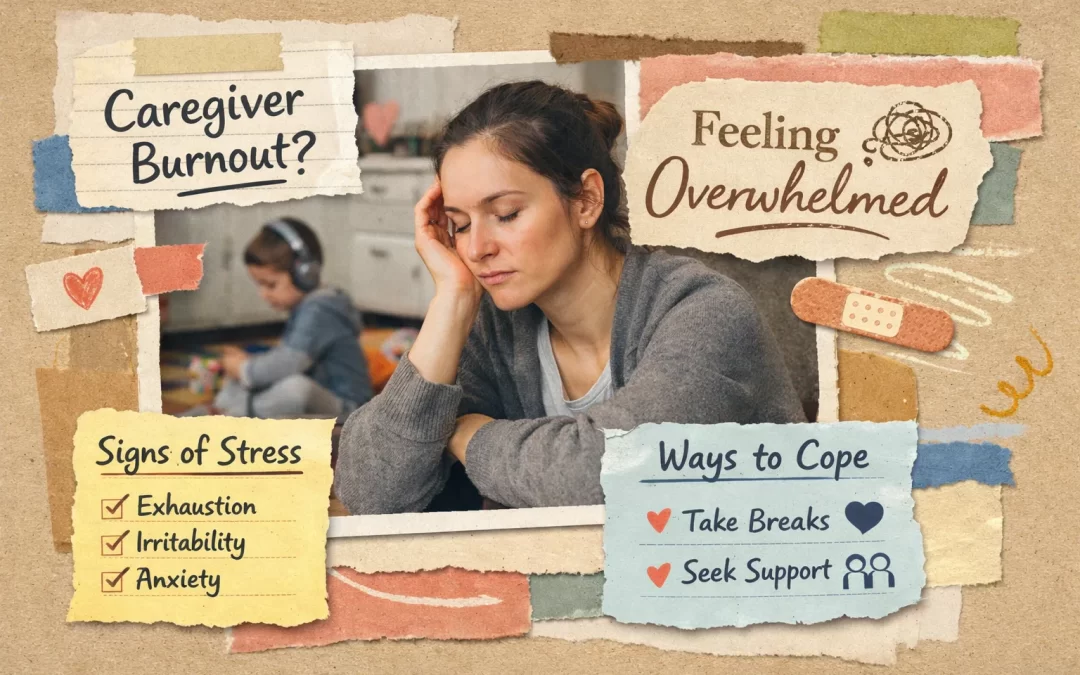
It’s 11pm. Your to-do list for tomorrow has fourteen items on it, and the feeling sitting in your chest isn’t frustration or even sadness. It’s a flat, hollow tiredness you can’t quite name, caregiver stress in autism often arrives this way, not as a dramatic breaking point but as a slow, accumulating weight. You’re not burned out, you tell yourself. You’re just a parent. You’ll sleep eventually. You’ll feel better when things calm down.
Here’s what the research actually says: depression affects approximately 45% of autism caregivers globally, a figure drawn from a meta-analysis of 40 studies (pooled prevalence 45%, 95% CI 39, 51), and some researchers have compared the stress profiles of mothers raising autistic children to those of combat veterans, based on documented similarities in PTSD symptom severity. That’s not a metaphor for dramatic effect. That’s a peer-reviewed finding. The gap between how serious this problem is and how little structured support most families receive is real, documented, and deeply unfair.
Reading further won’t fix everything, but it can help you name what’s happening and point you somewhere useful. Resources like Autism & Parents are built specifically around parent wellbeing, not just your child’s diagnosis. You deserve a place at that table too.
Why Autism Caregiving Places a Different Kind of Weight on You
This isn’t typical parenting stress with the volume turned up. The burdens autism caregivers carry are structurally different, and research on longitudinal caregiver outcomes suggests they often persist over time rather than resolving as children grow. Understanding that distinction matters, because it stops you from measuring yourself against a standard that was never meant to apply to your situation.
Consider the appointment and coordination tax alone. Many families manage multiple weekly appointments across speech therapy, occupational therapy, ABA, pediatricians, and school evaluations, plus the phone calls, insurance disputes, and waitlist check-ins that live in between. This invisible second job compounds over years rather than decreasing. And unlike a paying job, no one gives you a performance review, a raise, or a Friday afternoon off.
Then there’s the emotional labor of school advocacy. IEP meetings and 504 discussions ask you to argue for your child’s rights using clinical language while remaining calm, professional, and cooperative with the very people who have the authority to say no. Parents and researchers who have written about advocacy burden describe it consistently: the exhaustion that comes from fighting for something while performing composure is difficult to explain to anyone who hasn’t done it. Most people in your life haven’t.
The loneliness underneath all the busyness is real too. Friendships drift when you’re unavailable for spontaneous plans. Social invitations stop when your child’s needs make outings unpredictable. Over time, many caregivers find themselves in a strange social isolation: surrounded by appointments and obligations, but profoundly alone in the actual experience of it all.
Recognizing Caregiver Stress in Autism: Signs and Signals
Research shows that approximately 20% of parents of autistic children are already in active burnout, with over 70% reporting high parenting stress. Those numbers aren’t here to alarm you. They’re here so you know that what you might be feeling isn’t weakness or insufficiency. It’s a predictable response to a sustained, high-demand situation without adequate support.
Emotional Warning Signs
The emotional warning signs tend to show up first, even if you don’t recognize them as burnout. Emotional exhaustion that doesn’t lift after rest may arrive alongside a growing detachment from your child, frightening even as you feel it. Persistent irritability and difficulty finding pleasure in time with your family can follow. A low-grade hopelessness that colors your thinking even on ordinary days is also a signal worth taking seriously. None of these feelings mean you love your child less. They mean your nervous system has been under load for too long.
Physical and Behavioral Warning Signs
Your body often sends signals before your mind does. Watch for persistent muscle tension in your shoulders, jaw, or lower back. Sleep disruption is a particularly telling sign: lying awake replaying the day, or waking too early with your mind already running. Appetite changes, frequent headaches, and fatigue that doesn’t improve with rest are all worth noting rather than dismissing as ordinary tiredness.
Behavioral changes round out the picture. Skipping meals, pulling back from exercise you used to value, withdrawing from the few social connections you have, or struggling to complete tasks you’d normally handle without difficulty, these are worth noticing. A simple self-check across three areas can help: How am I doing emotionally right now? What is my body telling me? What have I been letting slip in my own care? Honest answers to those questions are more useful than any formal checklist.
Caregiver Stress and Burnout in Autism: Coping Strategies Backed by Research
Studies consistently show that adaptive coping strategies reduce stress for autism caregivers, and three specific therapeutic approaches, Acceptance and Commitment Therapy (ACT), Cognitive Behavioral Therapy (CBT), and psychoeducation, show measurable, lasting results in randomized controlled trials and systematic reviews. This is a signal that specific ways of responding to stress genuinely work better than others, including therapy, which remains one of the most reliable tools available when access allows.
Acceptance is one of the most commonly cited effective strategies across caregiver research, and it’s often misunderstood. Acceptance is not resignation. It’s not giving up. It’s the deliberate choice to stop spending your primary emotional energy fighting the reality of your child’s diagnosis and redirect that energy toward the actual work of helping them. Positive reframing is a related skill: viewing your child’s challenges as learning moments rather than evidence of failure, yours or theirs. This shift is something you can practice deliberately, and it produces measurable reductions in distress over time.
Mindfulness shows up in the research with a specific and useful number: autism-adapted mindfulness programs reduce ASD caregiver stress by approximately 34%, according to a 2023 study examining structured mindfulness interventions for this population. The adaptation matters because standard mindfulness instruction wasn’t designed for someone whose phone might ring mid-session with a school nurse on the other end. Even five to ten minutes of body-focused breathing between tasks, without an app, a course, or a quiet room, produces real benefit. The evidence supports starting small. For more on structured mindfulness interventions and caregiver outcomes, see this open-access review.
Active coping consistently outperforms avoidance, and the contrast is significant. Caregivers who seek information, adjust routines, and ask for help report substantially lower stress than those relying on denial, self-blame, or isolation as primary coping tools. Avoidance provides short-term relief and long-term amplification. Small, incremental actions, even ones that feel inadequate to the scale of the problem, consistently move the needle in the right direction.
Short Daily Self-Care Routines That Fit a Real Schedule
Advice like “make sure you’re taking time for yourself” isn’t useful when every hour is already committed to someone else’s needs. This section skips the aspirational and focuses on what clinician guidance and caregiver research actually support for parents operating on constrained time and energy.
The five-to-fifteen-minute range is where most sustainable habits live for busy caregivers. Keep a water bottle within reach and one no-prep snack available, yogurt, an apple, because dehydration and skipped meals accelerate exhaustion in ways that compound quickly. A short walk or five minutes of stretching while your child plays independently counts as movement. Five minutes of deep breathing between tasks is enough to shift your nervous system’s baseline. One small daily pleasure done without guilt, a specific song, a short read, a hot coffee finished while it’s still hot, matters more than it sounds.
The concept of parallel self-care is worth adopting. Calming music that helps regulate your child also helps regulate you. Quiet side-by-side activities serve both of you. Using a predictable screen time window as a deliberate unplugging period for yourself isn’t a parenting failure. It’s a scheduled recovery strategy, and it works. The micro-boundary is another tool worth practicing: saying no to one non-essential obligation each day. Not dramatically or apologetically. Just: not today. That small act of energy preservation accumulates over time.
Where to Find Real Support: Respite Care, Organizations, and Free Resources
Knowing you need support and knowing where to find it are two different problems. Many caregivers stay stuck at the first one because the second feels too complicated to navigate when they’re already depleted. Here’s the practical infrastructure, with specific starting points.
Respite Care Options
Respite care in the US comes in two main forms. In-home respite brings a trained caregiver to your home so you can leave, sleep, or simply sit in a different room. Out-of-home respite includes day programs, parents’ night out programs, and crisis nurseries where your child spends time in a structured environment. The ARCH National Respite Network’s National Respite Locator is the primary search tool for finding local providers. Autism Speaks also maintains a respite resource directory. Funding often exists through Medicaid waivers and state Developmental Disabilities programs, though eligibility and availability vary significantly by state. The call to your state’s DD agency is worth making even if you’re unsure you qualify.
Broader Support Organizations
For families navigating services more broadly, The Arc of the United States and Easterseals are solid national starting points. Military families have access to respite through TRICARE and Military OneSource. Some states offer Lifespan Respite Program vouchers for unpaid caregivers. The landscape is patchwork, but it’s larger than most caregivers realize before they start looking.
If you’re not ready to call anyone yet, Autism & Parents, Support & Guidance for Newly Diagnosed Families is a free, no-signup, no-paywall resource with a dedicated parent wellbeing section covering burnout, caregiver identity, grief, and finding community. It’s designed for the period when you need structured, judgment-free guidance before you’re ready to join a group or make a phone call. No account required. No intake form. Just clear, practical information built around the reality of your experience. To jump straight into practical next steps, see the Start here, Autism and Parents page in the parent wellbeing section for concise, action-focused guidance.
You’re Not Starting From Zero Anymore
Go back to that 11pm version of you, staring at fourteen items on a list, feeling that hollow tiredness. That feeling has a name now. It has research behind it. It is shared by nearly half of all autism caregivers worldwide, see the relevant meta-analysis of caregiver depression, which means the problem isn’t you. It’s the mismatch between how demanding this role is and how little support the systems around you provide.
Recognizing parent stress in ASD caregiving is not weakness. For many caregivers, it’s the first accurate thing they’ve allowed themselves to think in a long time. You don’t need to implement twelve strategies by morning. Using one coping approach from this article is enough to start. Knowing burnout’s warning signs means you can catch it earlier next time. Having a list of resources means you’re not beginning from scratch when you need help.
Caring for yourself is not separate from caring for your child. It never was. When you’re ready, head to Start Here, Autism and Parents and start with the parent wellbeing section, it’s free, requires no account, and was built around exactly this kind of moment.